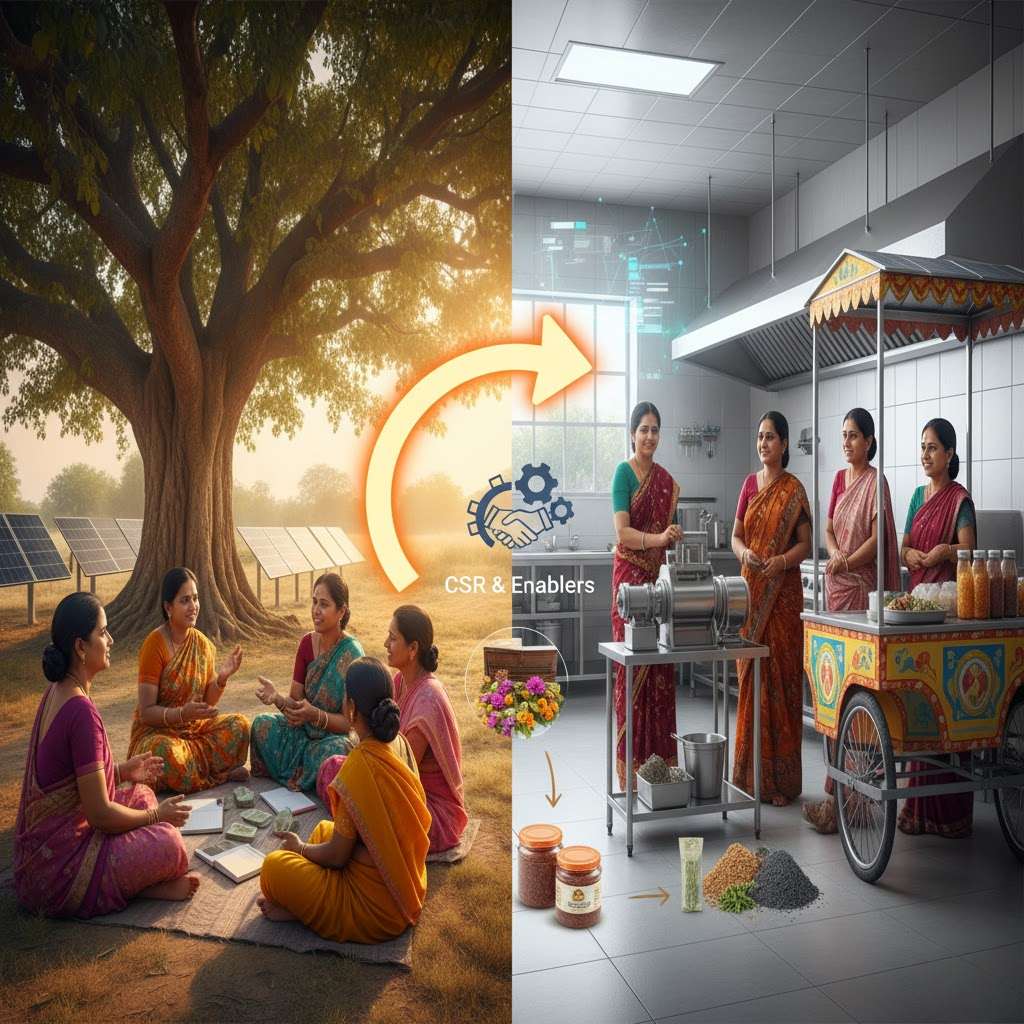
Author: Sunanda Shivhare (Director – Finance & Strategic Partnerships) Oct 14, 2025 In the evolving landscape of rural India, Self-Help Groups (SHGs) have long served as a vital foundation for financial inclusion and community-led growth. Now, a new chapter is unfolding—one that sees SHG members transforming into entrepreneurs and startup founders, thanks to sustained support through Corporate Social Responsibility (CSR) projects and ecosystem enablers. This journey—from grassroots collectives to independent business ventures—illuminates the power of women-led transformation across rural and semi-urban sectors. The Role of SHGs: Financial Backbone and Incubator Microfinance through SHGs is far more than just lending—it’s a conduit for empowerment. Various studies have highlighted how microfinance and entrepreneurial engagement via SHGs led to greater financial autonomy, decision-making capacity, broader social networks, and improved psychological well-being among rural women. Key Impact: SHGs function as accessible gateways to credit and savings for women who typically face barriers in accessing formal banking—without collateral, and often landless. In practice, SHGs function as accessible gateways to credit and savings for women who typically face barriers in accessing formal banking—without collateral, and often landless. They also foster a strong sense of collective responsibility. A CSR-backed support to set up a mustard oil expeller unit, in just a few months, can generate good revenue, transforming members’ lives and sparking entrepreneurial interest among nearby groups. CSR: The Catalyst From Groups to Growth CSR initiatives are playing a pivotal role in enabling SHGs to scale from collection-based entities toward actual businesses: Comprehensive Support The mustard oil startup received not just finance, but training, market strategy guidance, and institutional linkages—along with community infrastructure support from Panchayats. Ecosystem Partnerships Government agencies, NGOs, research institutions, and local governing bodies often collaborate, offering technical, regulatory, and promotional backing to these SHG-turned-enterprises. Scaling Impact: From Markets to Mobility The SHG-to-startup model is gaining widespread traction: Women’s SHGs are converting floral waste into products like gulkand, incense, dyes, and fresheners—blending sustainability with income generation. Supported through CSR, SHG women are running mobile cafes—shaping entrepreneurial identity and economic independence. SHG women bypass middlemen by selling directly to consumers—the initiative has boosted financial contribution and confidence among members. Emerging Ecosystems: Incubators and Institutional Support Two standout models exemplify structured transition from SHG to startup: Swayam Shikshan Prayog (SSP) 📍 Pune350,000+Women Supported Women-Led Climate Resilient Farming model and entrepreneurship programs focus on building agency and resilient income sources in areas like clean energy, agriculture, and nutrition. Enabling Women of Kamand (EWOK) 📍 IIT Mandi 12+ Startups Incubated 60+ Women Empowered Incubated by IIT Mandi, EWOK trains rural women in entrepreneurship—operating village-scale ventures and linking them to markets. To date, EWOK has incubated over 12 startups, directly empowering more than 60 women. Impact and Narratives Empowerment Beyond Income: According to a World Economic Forum report, Women in SSP’s programs have reported increased financial autonomy and improved decision-making capacity. Scaling Aspirations: Initiatives like ‘Lakhpati Didi’ have enabled women to achieve sustainable livelihoods, fostering a culture of entrepreneurship. Environmental and Social ROI: Projects converting waste into products not only generate income but also contribute to environmental sustainability. Institutional Fortification: Partnerships with institutions like NABARD and IIT Mandi strengthen the capacity of SHGs to operate as viable businesses. Looking Ahead: Scaling What Works To reinforce this transition from SHGs to startups, a multi-pronged strategy is essential: Expand SHG-based Startups: Leverage local resources (e.g., agriculture, waste) for diverse, scalable enterprises. Digital & Market Connectivity: Integrate e-commerce, mobile tools, and local market linkages to broaden reach. Structured Training: Focus on financial literacy, branding, digital tools, and managerial skills. Create Ecosystems: Build mentorship networks and access investor channels, aligning SHG entrepreneurial pathways with broader policy frameworks like Stand-Up India or Startup India. Measure & Share Impact: Regularly assess and communicate the outcomes of SHG-based startups to attract further support and investment. Empowering SHG women to become entrepreneurs isn’t just a gender equity imperative—it’s a scalable pathway to rural prosperity. When CSR, community structures, and institutional networks come together, SHGs emerge not just as savings groups, but as startups with a social mission. At Socion Impact, we envision a future where thousands of such stories redefine rural entrepreneurship and collective resilience. “At Socion Impact, we envision a future where thousands of such stories redefine rural entrepreneurship and collective resilience.”